
Whistleblowers Had a Record Year in 2025
It is time for our yearly review of the U.S. Department of Justice’s (DOJ) annual False Claims Act (FCA) statistics.
In fiscal year 2025,1 DOJ’s FCA statistics broke records in multiple categories. First, DOJ reported an overall total of $6.8 billion recovered through FCA settlements and judgments, of which $5.34 billion was recovered through qui tam actions. As DOJ noted in its press release, that is the highest total of any year.
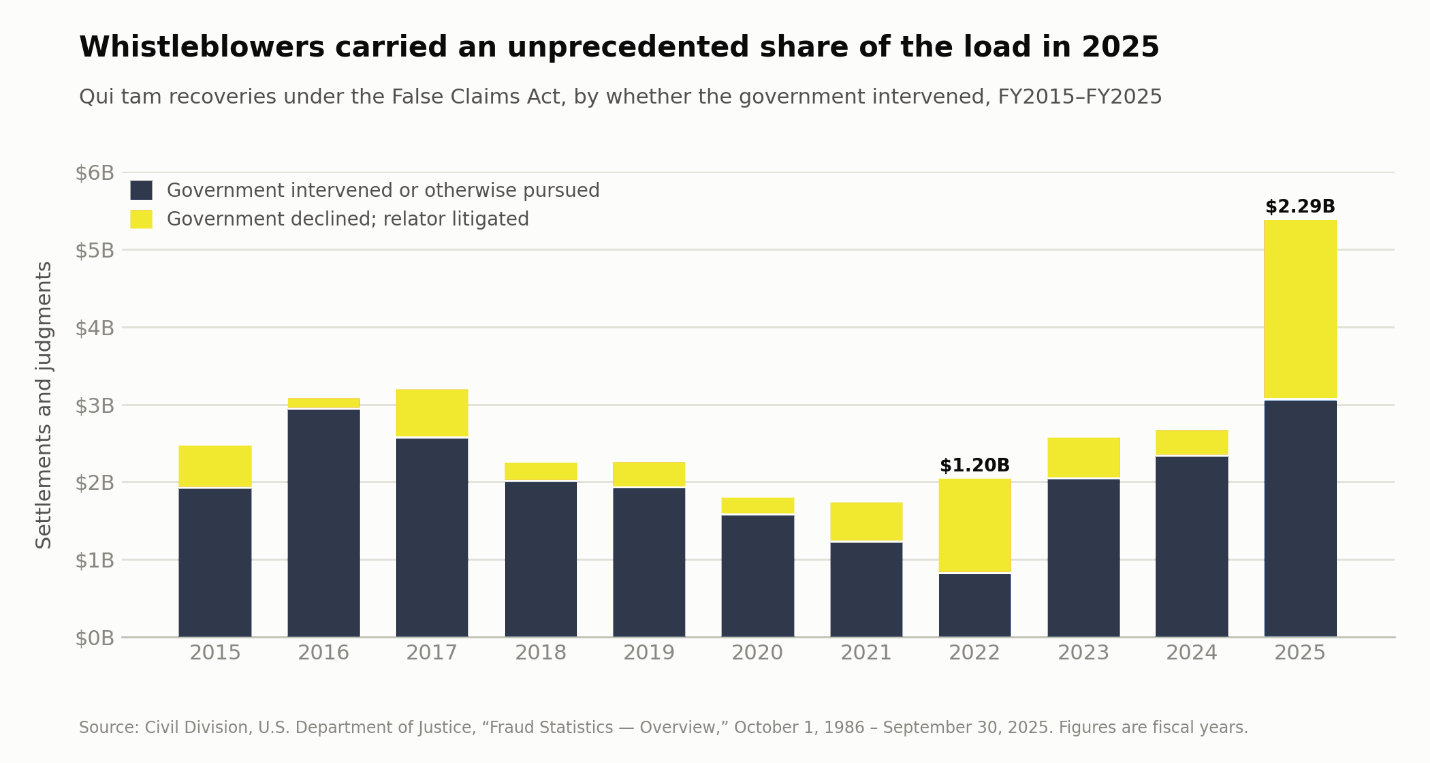
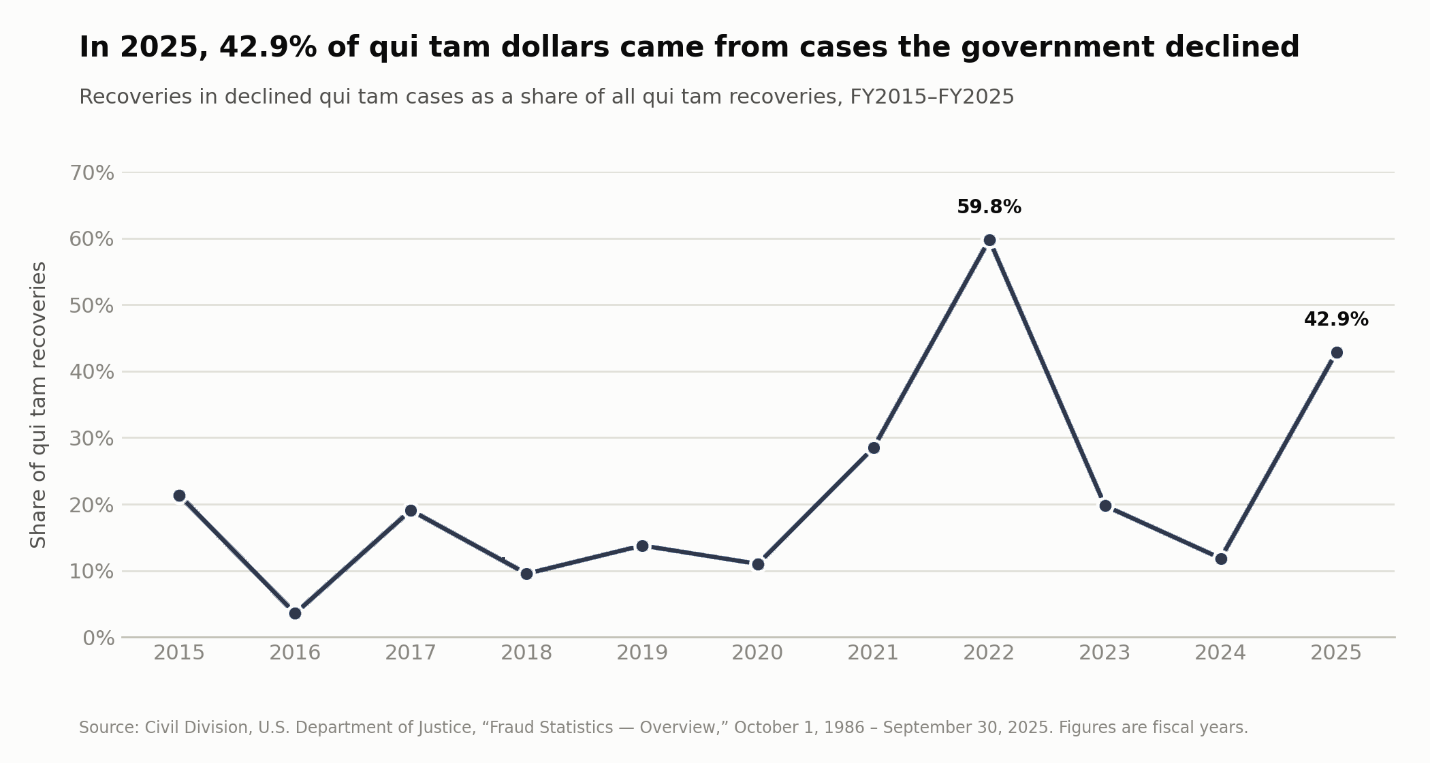
TAF Coalition has championed the importance of declined qui tam cases, relator cases where the whistleblower proceeds to litigate the case after the government chooses not to intervene and take over the case. DOJ reported an impressive $2.29 billion recovered through declined qui tam settlements and judgments in 2025. That is almost twice as much as the prior record amount in 2022 ($1.20 billion). In 2025, 42.9% of DOJ’s reported qui tam recoveries came from declined cases—exceeded only by 2022, when the ratio was 59.8%.
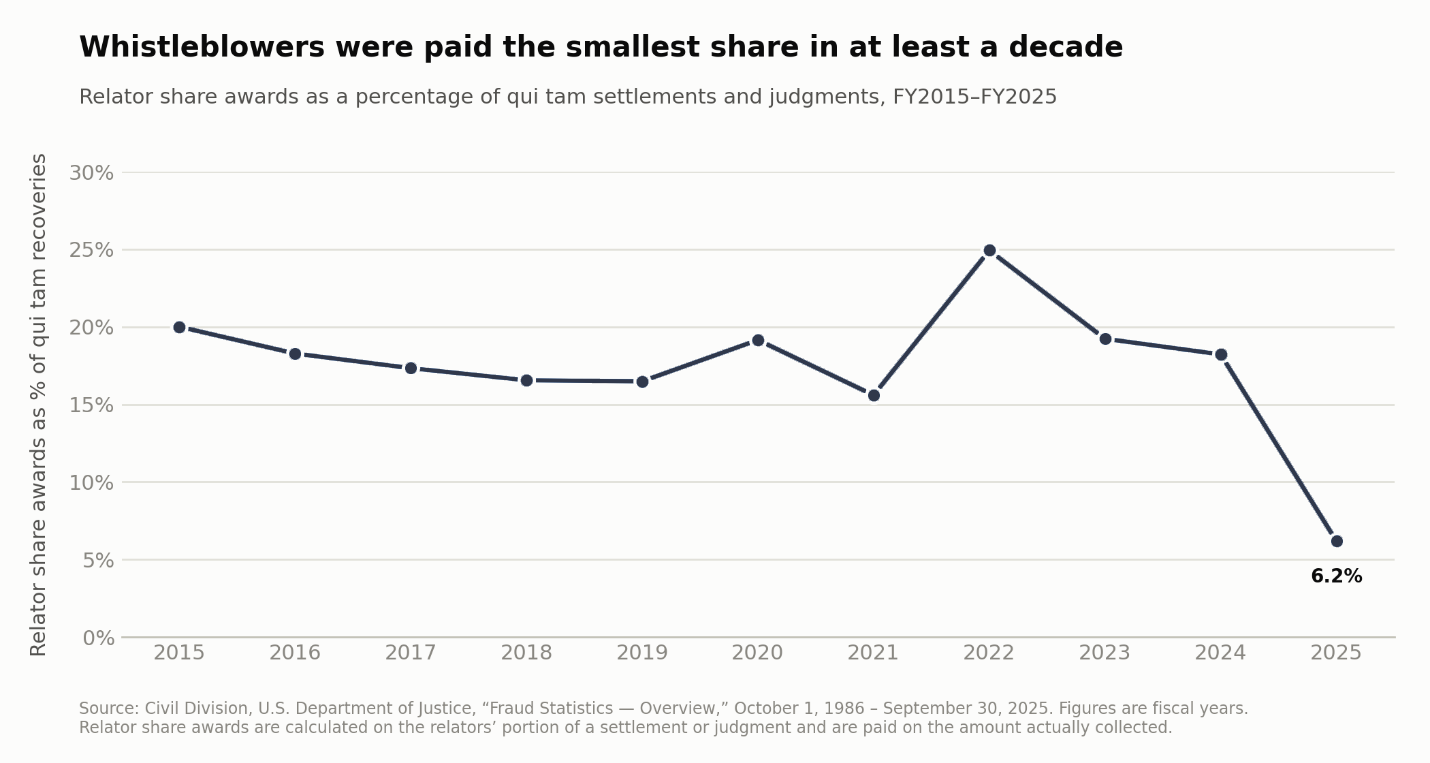
However, much of the declined-case total is driven by large judgments that are on appeal and therefore have not yet resulted in any actual money returned to the government. This is also why the total of relator shares—the rewards paid to the whistleblowers—was glaringly low in 2025. About $330 million was awarded to qui tam relators, which is only about 6.2% of the $5.34 billion that qui tam actions recovered.
The largest 2025 declined-case judgments were the $1.6 billion judgment against Johnson & Johnson subsidiary Janssen Pharmaceuticals, as well as a $290 million judgment against CVS Caremark. Both of these cases are pending on appeal to the U.S. Third Circuit Court of Appeals, so no relator share has been awarded.
These two cases also drove up the proportion of money recovered through FCA settlements and judgments that is healthcare related. While healthcare fraud always dwarfs other types of fraud prosecuted through the FCA, 2025 also saw an increase in defense fraud recoveries, with $553 million recovered through qui tam actions. There was also a reduction from 2024’s record high of “Other” (non-healthcare and non-defense) fraud, with $306 million recovered through qui tam actions.
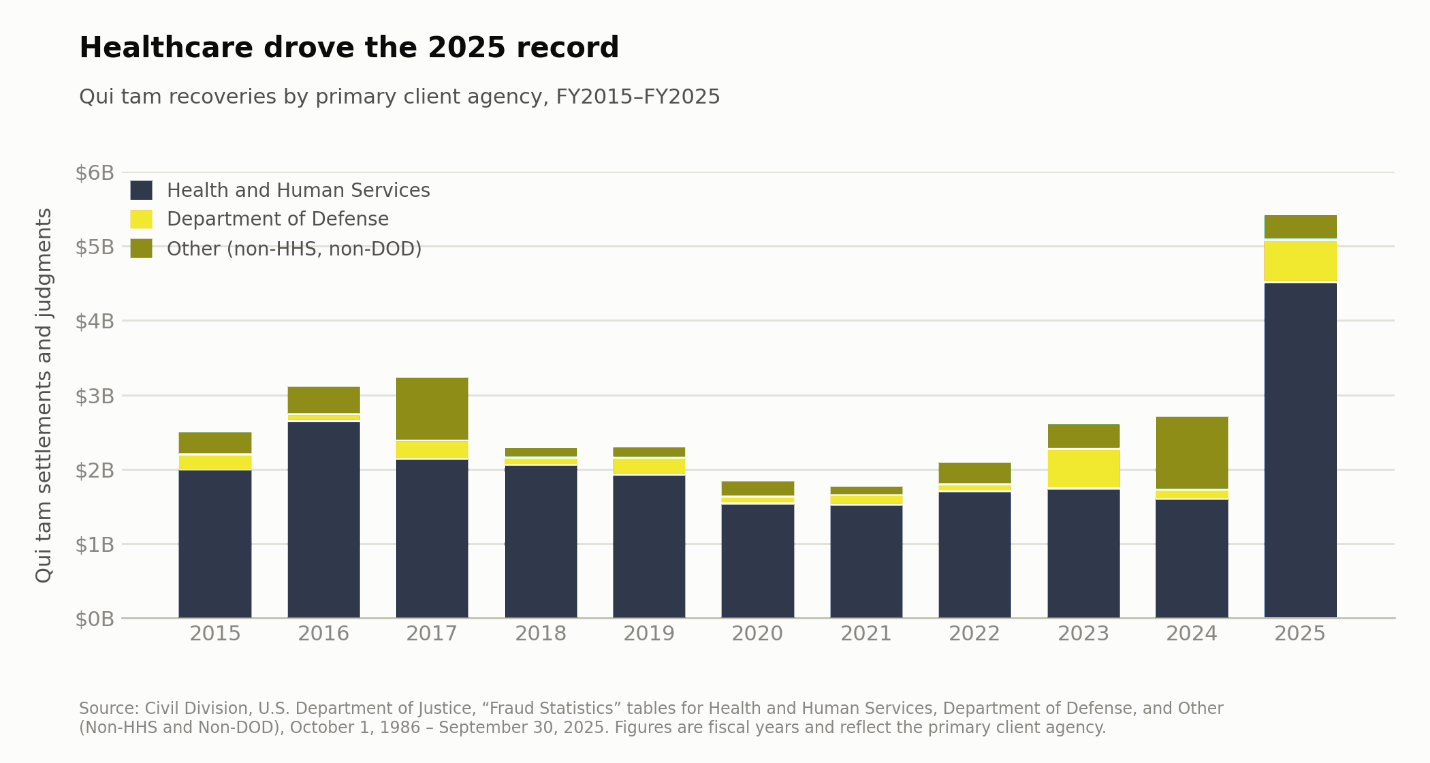
We presume that the reduction in “Other” fraud is due to the waning of Paycheck Protection Program (PPP) cases that skyrocketed in the wake of the Covid pandemic. The increase in defense cases is also heartening; as we have frequently noted, the original purpose of the FCA was to prevent war fraud, and the languishing of that category in prior years has been disappointing given the vast sums that the federal government spends on the Department of Defense.
An inarguable 2025 record was the highest ever number of new FCA qui tam actions, 1,297. That breaks the record set by the previous year, 2024, when 980 qui tam actions were filed. The number of new qui tam actions has been accelerating in the past few years, as the below chart shows.
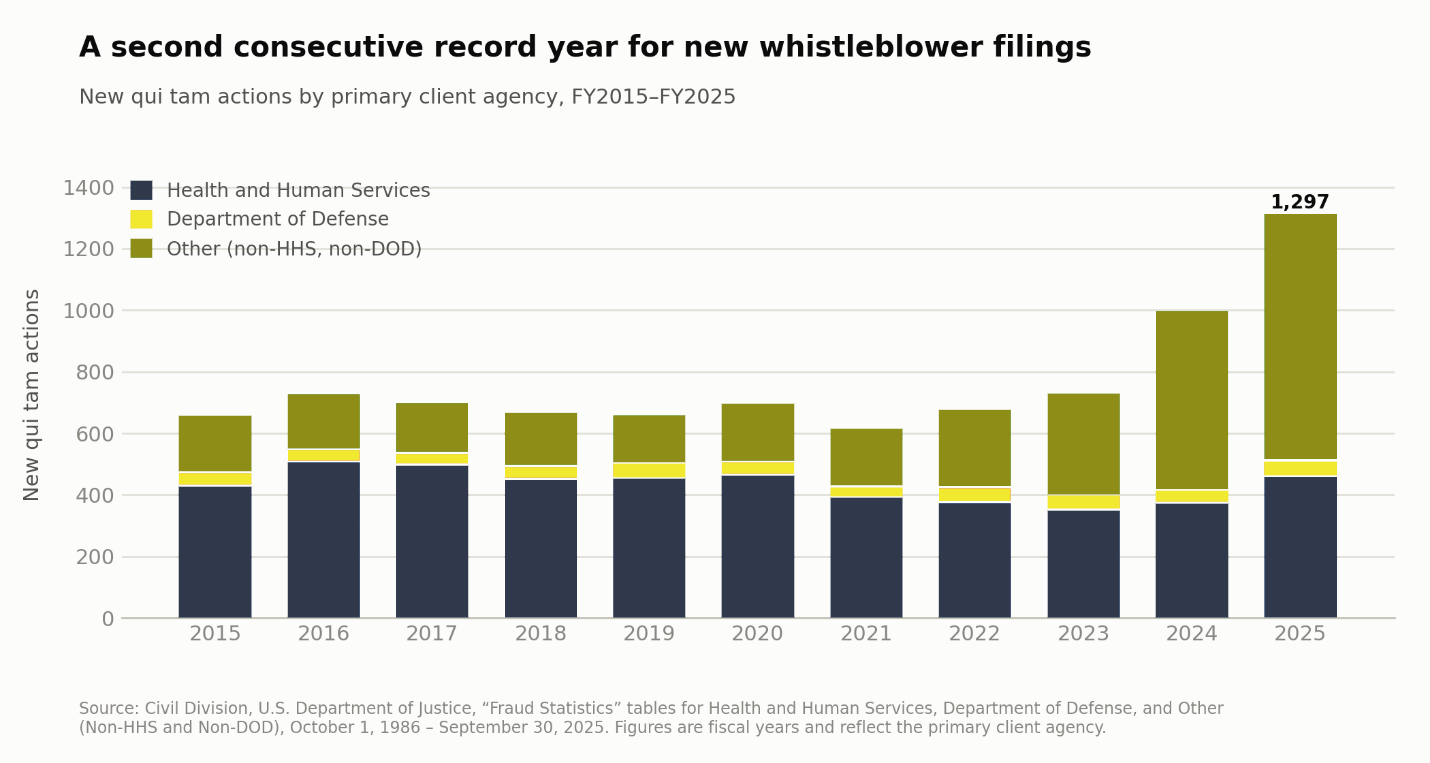
It appears that DOJ believes the growing number of new qui tam actions is being driven by AI-powered “data miners” hunting for fraud in publicly-available data. DOJ recently invited more of these cases through its “FOCUS initiative,” which prioritizes “insightful application of sophisticated technological capabilities to regulatory frameworks to help identify potential fraud that would otherwise go undetected.” Notably, the increase in new qui tam filings was driven almost entirely by “Other” (non-healthcare and non-defense) fraud.
As always, it is worth putting these numbers in perspective. The federal government spent $7.011 trillion in 2025 and recovered $5.34 billion lost to fraud through qui tam lawsuits (including the amounts pending on appeal), or about 0.076% of what it spent. As the below chart shows, that percentage had dropped during the pandemic, but has now recovered.
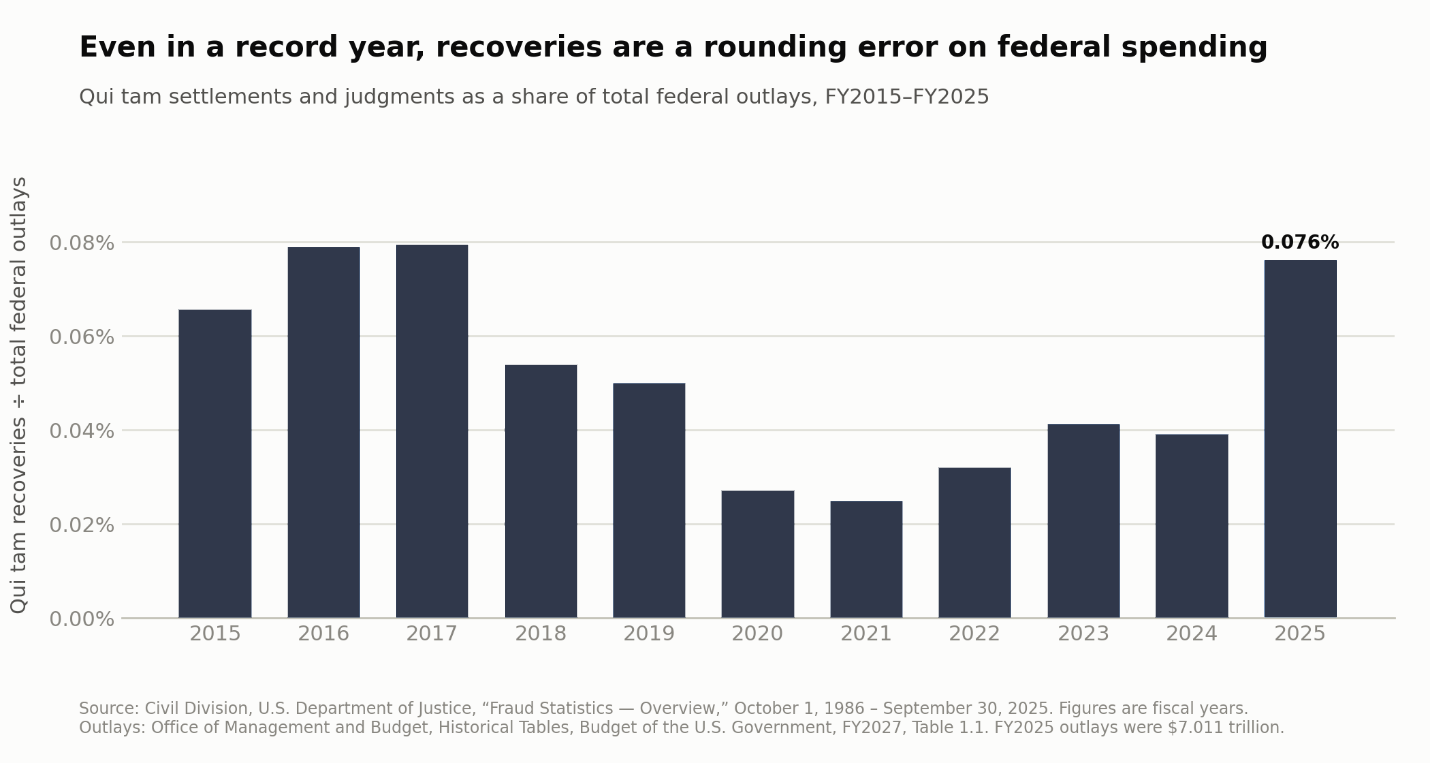
All available estimates suggest that there are billions of dollars of fraud that remain uncovered each year. So, while the percentage of federal money recovered by qui tam actions has risen, we know that there is much more that can be done through the FCA.
This piece was written by Nick Mendoza, a Senior Associate with Murphy Anderson PLLC
1 All years referenced are the fiscal year, which for 2025 runs from October 1, 2024 to September 30, 2025.
