
The Government Can’t Fight Fraud Without Fraud Fighters
With a record number of whistleblowers filing False Claims Act (FCA) cases, and an administration that has declared that fighting fraud is a priority, the stage has been set for an unprecedented effort to recover taxpayer money lost to fraud. That effort requires government resources; specifically, it requires government lawyers and agents who are focused on investigating and enforcing the False Claims Act.
We have previously highlighted the vast disparity between the resources that the government commits to fighting fraud, and the resources available to the companies accused of committing fraud. The administration’s emphasis on fraud is an invitation to narrow the gap.
First, a reminder: when a whistleblower files an FCA case, the U.S. Department of Justice is charged with investigating and, if the government decides to intervene, prosecuting the case. An Assistant U.S. Attorney (AUSA) from the district in which the case is filed is assigned to represent the government in the case. Typically, a lawyer from the Fraud Section of the DOJ’s Civil Division is also assigned to the case. The FBI or the Offices of Inspectors General (OIGs) can also provide agents to investigate the allegations. To quickly and effectively pursue fraudsters, the government needs sufficient government lawyers and agents to evaluate FCA cases.
For 2027, the administration is seeking about $477 million to fund the DOJ Civil Division, which will fund 1,166 attorneys along with supporting personnel. That’s an increase from last year’s request (DOJ asked for 1,002 attorneys in 2026), but most of the Civil Division defends the government from cases filed against it, and defending lawsuits appears to be the purpose for all of the increase in Civil Division staffing.1 The Civil Fraud Section, which enforces the FCA, is a relatively small office.
DOJ’s Criminal Division is seeking to fund 601 attorneys (up from its 2026 request of 530). For the U.S. Attorneys’ offices, DOJ is seeking to fund 6,244 AUSAs and supervisors, up from 6,144 in 2026.
The increase to the U.S. Attorneys’ staffing is entirely for the purpose of bolstering criminal prosecution, not civil enforcement, and the budget for civil AUSAs remains flat.
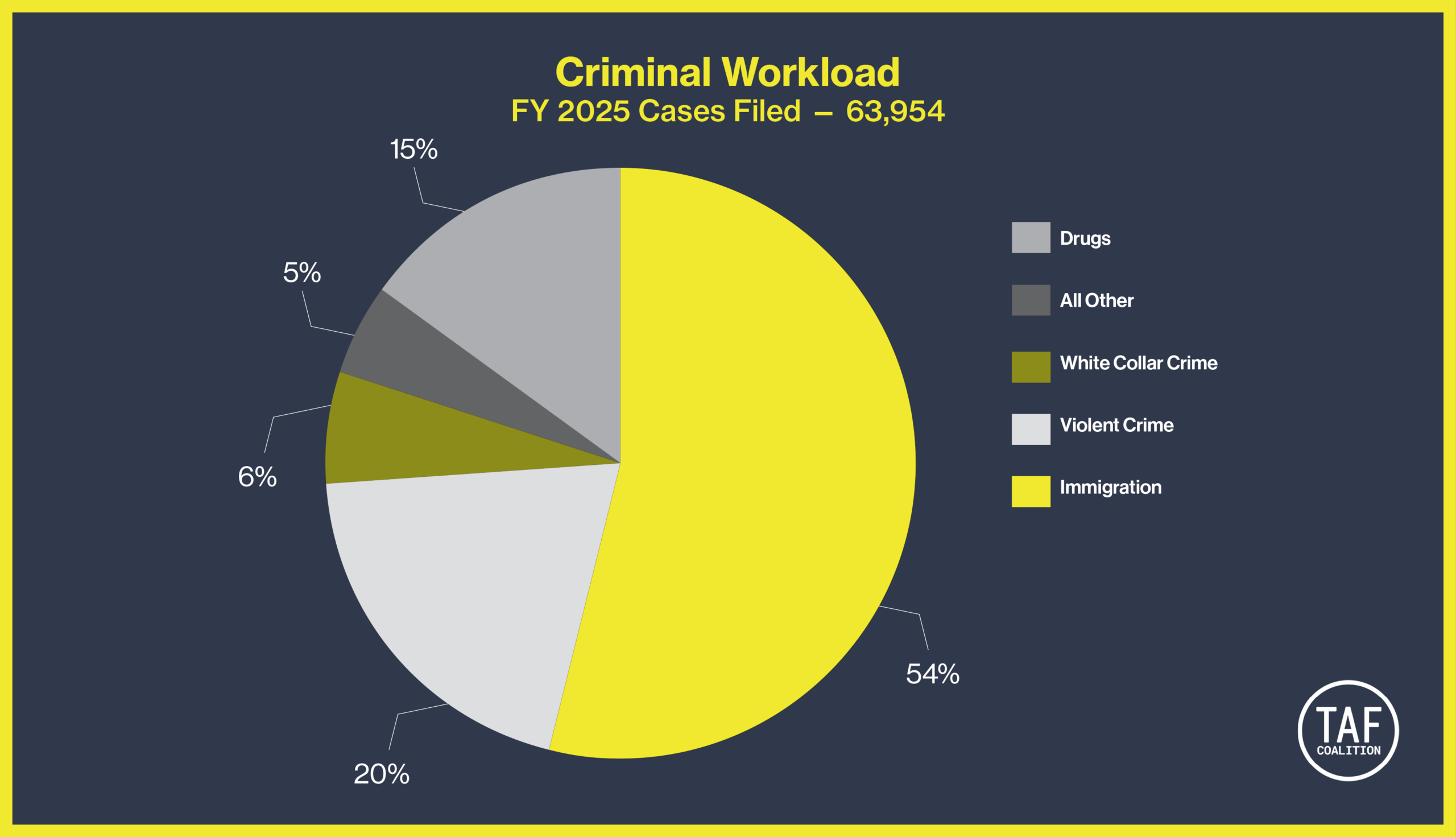
The criminal workload has also been reoriented toward immigration, not fraud. White collar crime prosecution in 2025 accounted for only 6% of the U.S. Attorneys’ criminal docket, down from 7% in 2023. The below pie chart comes from the U.S. Attorneys’ budget request.
Staffing the agencies that investigate fraud for DOJ has also not been prioritized. The Department of Health & Human Services OIG, which DOJ relies on to investigate Medicare and Medicaid fraud, projects that it will have 1,445 full-time employees in 2027, which the agency itself calls, “the lowest staffing level for OIG in two decades.”
In its budget request to Congress, the HHS OIG warns that there are “400 to 450 viable fraud cases and over 5,000 hotline complaints each year on which OIG is unable to follow up for lack of investigative resources” and “that OIG will be unable to pursue at least 1,200 viable fraud cases over the next 3 years without adequate resources.” OIG’s lack of resources is costly; the U.S. Government Accountability Office (GAO) estimates that Medicare and Medicaid lost $94 billion through “improper payments” in 2025.2 State Medicaid Fraud Enforcement Unit recoveries scratch the surface of this, recovering nearly $2 billion in 2025 alone.
This piece was written by Nick Mendoza, a Senior Associate with Murphy Anderson PLLC
1 DOJ is requesting $11.3 million and 35 attorneys to defend against lawsuits related to contaminated water at Camp Lejeune, North Carolina, after Congress passed a relevant law.
2 $57 billion from Medicare and $37 billion from Medicaid. $186 Billion Was Lost to Improper Payments Last Year. How Can We Prevent Them in the Future?, U.S. Gov’t Accountability Off. (June 4, 2026), https://www.gao.gov/blog/186-billion-was-lost-improper-payments-last-year-how-can-we-prevent-them-future.
