
What in the World is a NAMFCU or a MFCU?
The National Association of Medicaid Fraud Control Units (“NAMFCU”) is an association of all 53 federally certified Medicaid Fraud Control Units (“MFCUs”)[1]. MFCUs are offices that work within, or alongside, state attorneys general offices to investigate and prosecute Medicaid provider fraud[2]. NAMFCU aims to support state MFCUs in their pursuit to combat provider fraud and to protect care facility residents[3]. The organization provides education, training, and technical support to state MFCUs[4]. Most importantly, NAMFCU supports interstate enforcement cooperation and helps coordinate investigative efforts that involve multiple states and the federal government[5]. These multi-state and federal investigations are called global cases and can impact millions of beneficiaries and involve millions of dollars[6].
NAMFCU: A History
When the Medicaid program was first enacted, it lacked specific enforcement agencies focused on monitoring criminal activity in the program[7]. As the program began growing, so did concern about fraud and abuse[8]. In response to reports of fraud and resource constraints of state offices, Congress passed the Medicare-Medicaid Anti-Fraud and Abuse Amendments of 1977[9]. The Act was designed to strengthen the ability of the government to detect and punish fraud on the Medicaid and Medicare programs[10]. Ultimately, the Act provided states the opportunity and partial funding to establish a MFCU[11]. NAMFCU was later established in 1978 to help support MFCUs in their efforts to combat fraud[12].
How do MFCUs Work?
Today, every state must have a MFCU, unless it can demonstrate that it has minimal fraud in its Medicaid program and that its beneficiaries are adequately protected[13]. A MFCU consists of state attorneys, investigators, and auditors who work together to investigate and prosecute fraud[14]. MFCUs investigate all types of fraud involving Medicaid healthcare providers, but do not investigate Medicaid recipients unless they conspire with a provider[15].
The U.S. Department of Health and Human Services Office of the Inspector General (“HHS OIG”) monitors each state MFCU[16]. Each year, HHS OIG recertifies MFCUs based on their compliance with federal requirements and program performance[17]. MFCUs must be “devoted exclusively to investigating and prosecuting provider fraud and resident abuse” in Medicaid[18] Each MFCU receives up to 75% of its funding from the federal government with the remaining coming from state funding[19].
Impact of NAMFCU & MFCUs
MFCUs bring massive returns on their investment. For every $1 spent, MFCUs recover $4.64[20]. MFCUs also boast successes in obtaining criminal convictions alongside civil recoveries.
From 2015 through 2025, MFCUs obtained 13,050 criminal convictions involving Medicaid fraud and abuse[21]. Over the same time period, MFCUs also obtained 7,085 civil settlements and judgments[22]. In fiscal year 2025 alone, MFCUs obtained 1,185 convictions and recovered nearly $2 billion in both civil and criminal recoveries[23]. Together with NAMFCU, MFCUs have recovered $9.18 billion in civil recoveries and over $5.6 billion in criminal recoveries over the past decade[24]. Of this, NAMFCU has coordinated investigations resulting in over $4.7 billion in civil recoveries[25]. The most successful year for global recoveries was in 2023, with global recoveries reaching a staggering $1.2 billion[26].
Civil Recoveries[27]
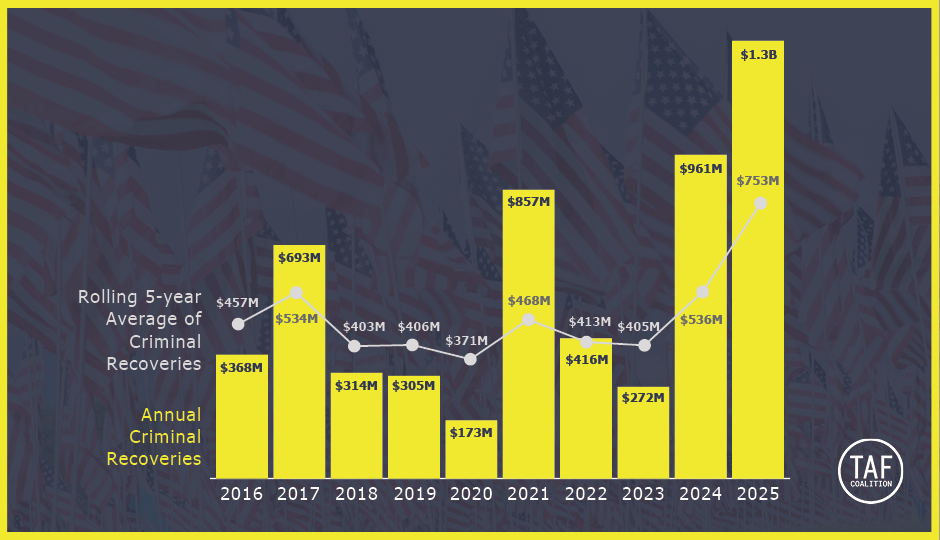
Global vs. Non-Global Civil Recoveries[28]
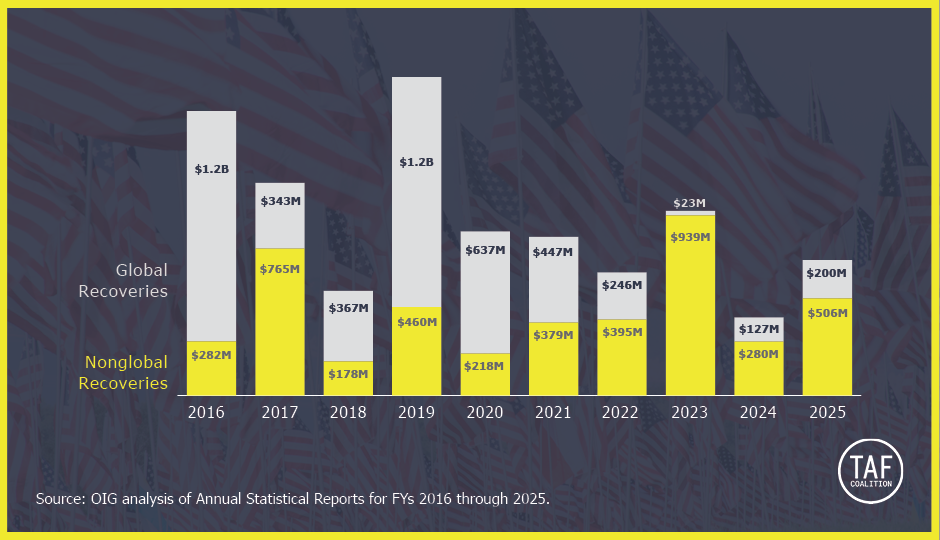
Criminal Recoveries[29]

NAMFCU and MFCUs remain critical combatants in the fight against fraud. For more information about your state’s MFCU and NAMFCU, please visit their website.
How Whistleblowers Can Help
Whistleblowers are critical in detecting and combatting provider fraud. The False Claims Act and their state law counterparts allow private individuals, known as relators, to bring qui tam actions on behalf of the government against those who defraud the government. If the government recovers funds, the whistleblower may be entitled to receive between 15% and 30% of the recovery as a reward. The federal FCA has crucial anti-retaliation protections that protect whistleblowers from termination, harassment, or other adverse employment actions. State analogs of the FCA also have these provisions. Learn more about state false claims act in TAF’s State False Claims Acts Fact Sheet.
Those with relevant information should consult with a qualified whistleblower attorney to understand their rights and options before coming forward.
[1] National Association of Medicaid Fraud Control Units, Nat’l Ass’n Atty’s Gen., https://www.naag.org/about-naag/namfcu/ (last visited June 16, 2026).
[2] 42 C.F.R. § 1007.7 (describing the three types of organization styles each MFCU can enact).
[3] National Association of Medicaid Fraud Control Units, supra note 1.
[4] Id.
[5] Id.
[6] National Association of Medicaid Fraud Control Units, supra note 1; see e.g., Medicaid Fraud Control Units Annual Report: Fiscal Year 2025, Dep’t Health & Hum. Serv. Off. Inspector Gen. (Mar. 2026), https://oig.hhs.gov/documents/evaluation/11553/OEI-09-26-00140.pdf.
[7] About the Medicaid Fraud Control Units, Nat’l Ass’n Att’ys Gen., https://www.naag.org/about-naag/namfcu/about-the-medicaid-fraud-control-units/ (last visited June 16, 2026).
[8] Barbara Zelner, Medicaid Fraud in State Attorneys General Powers & Responsibility, 379 (Emily Myers, National Association of Attorneys General, 4th ed. 2018).
[9] National Association of Attorneys General, supra note 8; Pub. L. 95-142, 91 Stat. 1175 (1977).
[10] National Association of Attorneys General, supra note 8.
[11] Pub. L. 95-142, 91 Stat. 1175 (1977).
[12] About the Medicaid Fraud Control Units, supra note 7.
[13] National Association of Attorneys General, supra note 8.
[14] About the Medicaid Fraud Control Units, supra note 7.
[15] Id.
[16] Medicaid Fraud Control Units Annual Report: Fiscal Year 2025, supra note 6.
[17] Id.
[18] Zelner, supra note 8, at 381-82.
[19] Id.
[20] Medicaid Fraud Control Units Annual Report: Fiscal Year 2025, supra note 6.
[21] Id.
[22] Id.
[23] Id.
[24] See id.
[25] See id.
[26] Id.
[27] Medicaid Fraud Control Units Annual Report: Fiscal Year 2025, supra note 6.
[28] Id.
[29] Id.
