
Approaches to Alternate Remedies Under 31 U.S.C. § 3730(c)(5)
Overview
What precisely qualifies as an alternative remedy is an open question in most circuits. The majority adopt a framework that compares the underlying facts and nature of the relator’s allegations to the nature and facts of an alleged alternate remedy proceeding. Generally, an alternate remedy must address the same type of fraud or harm as the underlying qui tam action. A relator’s standing to intervene in an alternate remedy is limited; the majority of courts prohibit intervention in criminal proceedings even if only to secure a portion of the restitution.

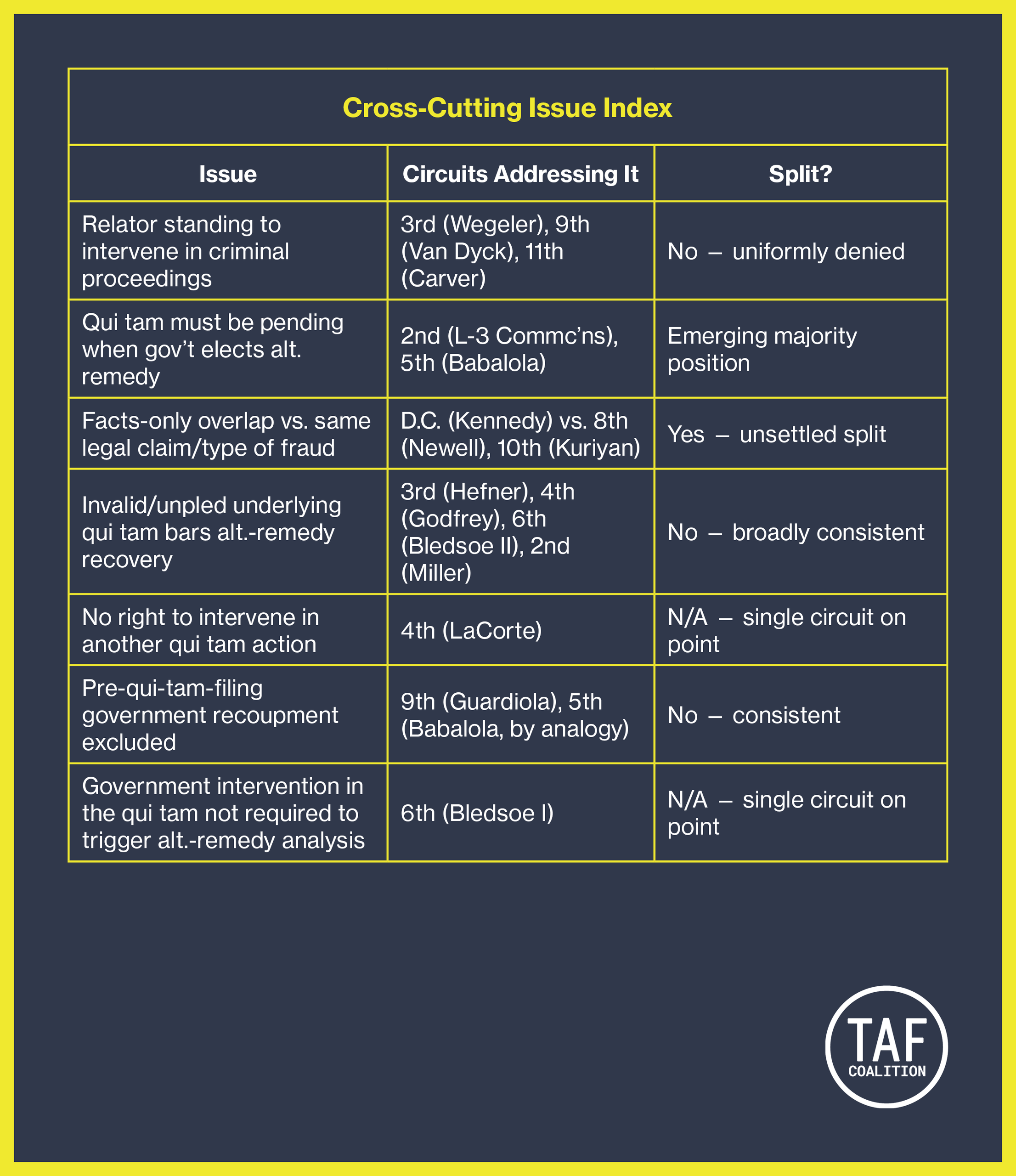
Cross-Cutting Issue Index
Several questions recur across circuits. Use this index to jump directly to an issue rather than reading circuit-by-circuit.
D.C. Circuit
Status: Controlling authority
Rule: An alternative remedy must redress the same type of falsity/fraud claim as the FCA qui tam — sameness of legal claim, not merely overlapping facts, controls.
Controlling Case Law
U.S. ex rel. Kennedy v. Novo A/S, 5 F.4th 47 (D.C. Cir. 2021)
Rule: For a relator to recover under § 3730(c)(5), the “alternative remedial proceedings from which a relator can recover a share must redress the same type of falsity and fraud claims that otherwise could be pursued by a private relator’s qui tam lawsuit under the [FCA].” (56) If the alternate proceeding is based on a claim the relator could not have brought, it is not an alternate proceeding from which the relator can recover. (56)
Holding: Denied a motion for relator’s share from a Food Drug & Cosmetic Act (FDCA) misbranding settlement involving overlapping facts with the relator’s off-label promotion FCA qui tam. The court concluded that the harm the FDCA addresses (protecting the public from being misled) and its remedies (equitable relief and fines/penalties) are fundamentally different from an FCA claim, which recovers for fraud depriving the government of its property. (56)
Key Language:
• “it is the nature of the legal claim—the fraudulent or false deprivation of a monetary or property interest—and not the commonality of facts that determines a relator’s right to share in an alternative recovery.” (57)
Key Facts: Relator brought a qui tam alleging off-label marketing of a diabetes drug to non-diabetic patients. The case was consolidated with other actions, the U.S. intervened, and it settled. The U.S. then sued the same defendants under the FDCA for misbranding and obtained a settlement. The relator moved for a share of the FDCA settlement; the D.D.C. denied the motion and the relator appealed. (51-53)
Applications
U.S. ex rel. Vermont National Telephone Co. v. Northstar Wireless, LLC, 2025 WL 1113407 (D.D.C. Apr. 15, 2025)
Holding: Denied relator’s share from a separate FCC default ruling because the FCC proceeding was not an alternate remedy — it did not require the FCC to find that the defendant defrauded or submitted false statements to the government. (16)
Key Language:
• “It is not enough that the default payments arise from the same underlying set of facts as the qui tam action. The payment must be legally connected to alleged fraud.” (17)
Key Facts: Relator alleged defendants conspired to defraud the government by falsely certifying eligibility for FCC small-business license discounts. (1) The FCC found defendants eligible for the licenses but not the discounts, without finding lack of candor, revoked the discount, and later ordered a default payment plan after defendants said they would default. Relator sought a share of the FCC default payment plan.
First Circuit
Status: No controlling authority
Rule: No controlling circuit authority; district courts apply the Sixth Circuit’s Bledsoe framework, asking whether the qui tam allegations sufficiently overlap with the government’s separate recovery.
District Court Decisions
U.S. ex rel. Birchall v. Spinefrontier, Inc., 2024 WL 4686985 (D. Mass. Nov. 4, 2024)
Holding: Granted relator’s motion for a share of a government settlement with individuals named in the relator’s complaint but not sued as defendants. Applying Bledsoe, the court found the relator’s allegations sufficiently overlapped with the government’s settlement to qualify as an alternate remedy. (7, 23)
Key Facts: Relators alleged a medical device company and affiliates caused submission of kickback-tainted claims by paying surgeons unlawful remuneration; the complaint named several non-defendant surgeons. The government investigated and separately settled with those surgeons, then partially intervened in the qui tam, expressly referencing the relator’s allegations and the surgeon settlements. Relators moved for a share of the surgeon settlements. (3-4)
U.S. ex rel. Willette v. University of Massachusetts, 2016 WL 3747532 (D. Mass. July 11, 2016)
Holding: Denied relator’s motion for a share of misappropriated-funds recovery; no evidence the defendant’s repayment was motivated by the relator’s suit or that the government took affirmative action to enforce repayment, so it was not an alternate remedy. (5)
Key Facts: Relator alleged embezzlement of funds by a co-worker at a federally-funded university, which he had reported internally. (1-3) While the qui tam was pending — but before defendants knew of it — defendants voluntarily contacted state agencies, entered a repayment plan, and repaid it in full. (1-3)
Second Circuit
Status: Controlling authority
Rule: An alternate remedy includes civil actions initiated by the government while a qui tam is pending; the qui tam must be pending at the time the government elects the alternate remedy. (28)
Controlling Case Law
U.S. v. L-3 Commc’ns EOTech, Inc., 921 F.3d 11 (2d Cir. 2019)
Rule: A valid qui tam action must be pending at the time the government selects an alternate remedy.
Holding: Affirmed denial of relator’s motion for a share of settlement proceeds because the relator voluntarily dismissed his qui tam before the government initiated its own suit. The court found his claim of government coercion unsupported, so the voluntary dismissal was treated as if the qui tam never existed. Because a qui tam must be pending when the government elects an alternate remedy, the motion was denied. (17-18, 30)
Key Facts: While an active fugitive on unrelated charges, relator sued a defense contractor alleging defective firearm sights. (15-16) Facing dismissal for fugitive status, relator voluntarily dismissed without prejudice before the government could move to dismiss. (15-16) A year later the government brought its own FCA action, which settled; relator moved for a share as an alternate remedy. (16)
Miller v. U.S. ex rel. Miller, 110 F.4th 533 (2d Cir. 2024)
Rule: “A relator must plead a valid FCA claim to be eligible to seek a share of the government’s recovery under the FCA’s alternative remedy provision.” (550)
Holding: Affirmed denial of relator’s motion for a share of a government consent-decree payment because the relator had not pled a valid qui tam action. The discretionary fines allegedly avoided were not established payment obligations and did not form a valid FCA claim; the complaint also failed Rule 9(b) particularity.
Key Facts: Relator brought a reverse-false-claim suit alleging a credit card issuer avoided civil penalties owed to the CFPB and OCC by falsifying internal audit procedures for third-party vendors. While the qui tam was pending, defendants entered an OCC consent order addressing compliance failures other than those in the relator’s complaint. (538)
Third Circuit
Status: Controlling authority
Rule: Relators are not entitled to a share of an alternate remedy where the underlying qui tam is invalid; a criminal proceeding is not an alternate remedy, and relators may not intervene in criminal proceedings to seek a share of restitution.
Controlling Case Law
U.S. ex rel. Hefner v. Hackensack University Medical Center, 495 F.3d 103 (3d Cir. 2007)
Rule: Relators are not entitled to a share of an alternate remedy when their underlying qui tam is invalid. (112) (Following Bledsoe.)
Holding: Affirmed denial of reconsideration of summary judgment for defendants and denial of relator’s motion for a share of a government settlement because the underlying qui tam was invalid.
Key Facts: Relator alleged a medical center and affiliates improperly billed Medicare while receiving grant funding. (107-08) Before the qui tam was filed, defendants had disclosed the improper reimbursements to Medicare and repaid it. (107) The D.N.J. granted summary judgment for defendants for insufficient evidence of scienter. (108)
U.S. v. Wegeler, 941 F.3d 665 (3d Cir. 2019)
Rule: A criminal proceeding is not an alternate remedy to a qui tam action under the FCA — a relator cannot intervene in a criminal prosecution even solely to assert a share of restitution. (672) “FCA does not provide a right to intervene to recover a share of the proceeds derived from a proceeding that the government pursues under the alternate-remedy provision.” (672)
Holding: Affirmed denial of relator’s motion to intervene in a criminal proceeding as an alternate remedy; relator lacked standing and the FCA does not provide a right to intervene to recover an alternate-remedy share.
Key Facts: Relator’s qui tam alleged false reimbursement claims to the Department of Education; information she provided led to a criminal tax fraud prosecution of one defendant, who agreed to pay $1.5M restitution under a plea deal. The government declined to intervene in the qui tam; relator’s motion to intervene in the criminal proceeding to secure a restitution share was denied. (668-69)
Fourth Circuit
Status: Controlling authority
Rule: Relators are not entitled to a share of an alternate remedy when their underlying qui tam is invalid; § 3730(c)(5) does not confer a right to intervene as an alternate remedy in another qui tam action.
Controlling Case Law
U.S. ex rel. Godfrey v. KBR, Inc., 360 Fed. App’x 407 (4th Cir. 2010)
Rule: Relators are not entitled to a share of an alternate remedy when their underlying qui tam is invalid. (413) (Following Bledsoe and Hefner.)
Holding: Affirmed dismissal of relator’s procurement-fraud allegations for lack of Rule 9(b) particularity. Following Bledsoe, held the relator was not entitled to any alternate remedy the government pursued because the underlying FCA claim failed. (410-13)
Key Facts: Relator alleged a defense contractor submitted inflated invoices, falsely certified contractual compliance, and billed for equipment never provided. The district court dismissed for failure to plead with particularity and dismissed the alternate-remedy claim as premature absent evidence of a government settlement. (409-10)
U.S. ex rel. LaCorte v. Wagner, 185 F.3d 188 (4th Cir. 1999)
Rule: § 3730(c)(5) does not confer a right to intervene in another qui tam action as an alternate remedy. (191)
Holding: Overruled the district court’s grant of relators’ motion to intervene in another qui tam as an alternate remedy; § 3730(b)(5) prohibits intervention in a qui tam by any party other than the government, and the original qui tam was too attenuated from the global-settlement qui tam to be an alternate remedy.
Key Facts: First relators (R1) sued medical laboratories for false claims to federal health programs; the government intervened and settled with a broad release and a corporate integrity agreement (CIA). In a separate, later-consolidated set of qui tam proceedings with different relators and defendants, some conduct in the global settlement surfaced through audits conducted under R1’s CIA. R1 sought to intervene in the global settlement, arguing its action was a but-for cause; the district court granted intervention and the government appealed. (190-91)
Fifth Circuit
Status: Controlling authority
Rule: A valid qui tam action must exist at the time the government elects an alternate remedy.
Controlling Case Law
U.S. ex rel. Babalola v. Sharma, 746 F.3d 157 (5th Cir. 2014)
Rule: A valid qui tam must exist at the time the government selects an alternate remedy. (162-63)
Holding: Affirmed partial summary judgment for the government; relators were not entitled to a share of criminal restitution because no valid qui tam existed at the time of the criminal restitution proceeding. Reading the Fourth, Sixth, and Ninth Circuits as implicitly requiring a pending qui tam, the court held the FCA requires a qui tam to exist “at the time of the Government’s election of the alternate remedy.” (162-63) Procedural protections for relators guard against the government racing to the courthouse after pre-suit disclosures. (163)
Key Facts: Relators alleged healthcare providers submitted false claims to Medicare/Medicaid. Before relators sued, the government had already indicted the same providers criminally and obtained a restitution award. The district court granted partial summary judgment for the government because no qui tam was pending at the time of the restitution proceeding. (158-59)
Applications
U.S. ex rel. Westfall v. Medworx Compounding, LLC, 2024 WL 1184416 (S.D. Miss. Mar. 18, 2024)
Holding: Granted relators’ motion for a share of the government’s forfeiture recovery as an alternate remedy. The government pursued an alternate remedy by staying the qui tam and pursuing civil forfeiture and criminal cases against the pharmacy’s owners, “siphoning” off assets and circumventing the earlier-filed qui tam. (1-2)
Key Facts: Relators alleged an illegal kickback scheme (AKS/FCA) by a compounding pharmacy. The government stayed and sealed the qui tam while pursuing forfeiture and criminal cases against the owners, ultimately recovering $66.8M criminally, then declined to intervene in the qui tam. (1-2)
U.S. ex rel. Turner v. Gardens Pharmacy, LLC, 2022 WL 2079718 (S.D. Miss. June 9, 2022)
Holding: Denied relator’s motion to recognize a share of criminal forfeiture proceedings; the conduct alleged in the qui tam differed from the conduct in the government’s criminal cases against different defendants, and the relator’s information was unrelated to the conduct that produced the criminal charges and forfeiture. (9)
Key Facts: Relator alleged a pharmacy submitted kickback-tainted payments to government healthcare payors. The government separately pursued criminal proceedings against parties associated with, but not named in, the qui tam; relator sought a share of those recoveries as an alternate remedy.
Sixth Circuit
Status: Controlling authority
Rule: “Alternate remedy refers to the government’s pursuit of any alternative to intervening in a relator’s qui tam action” — intervention is not required — but the underlying qui tam must be adequately pled and must overlap with the government’s alternate proceeding.
Controlling Case Law
U.S. ex rel. Bledsoe v. Community Health Systems, Inc. (Bledsoe I), 342 F.3d 634 (6th Cir. 2003)
Rule: “Alternate remedy refers to the government’s pursuit of any alternative to intervening in a relator’s qui tam action.” (647)
Holding: Overturned dismissal of relator’s request to recognize the government’s settlement and for a relator’s share; remanded for further factual development. Held § 3730(c)(5) does not require government intervention before the alternate-remedy provision applies. (647)
Key Facts: Relator alleged a health care system engaged in fraudulent upcoding. The government separately entered a civil settlement with defendants; relator moved to recognize the settlement and share in its proceeds. The district court denied the motion and dismissed the qui tam with prejudice.
U.S. ex rel. Bledsoe v. Community Health Systems, Inc. (Bledsoe II), 501 F.3d 493 (6th Cir. 2007)
Rule: A qui tam must be adequately pled for a relator to assert a claim to a share of an alternate remedy. (522)
Holding: Denied relator’s motion for a share because the qui tam allegations did not overlap with the government’s settlement.
Seventh Circuit
Status: No controlling authority
Rule: No controlling circuit authority; district courts are split on whether criminal forfeiture qualifies as an alternate remedy.
District Court Decisions
U.S. v. Bisig, 2005 WL 3532554 (S.D. Ind. Dec. 21, 2005)
Holding: Held that criminal forfeiture qualified as an alternate remedy.
U.S. v. Lustman, 2006 WL 1207145 (S.D. Ill. May 4, 2006)
Holding: Rejected criminal forfeiture as an alternate remedy where the government had also intervened in the underlying qui tam action.
Key Facts: Cited in contrast to Bisig — illustrates the district split within the Seventh Circuit.
Eighth Circuit
Status: Controlling authority
Rule: An alternate remedy “does not include the government’s settlement of unrelated claims against unrelated parties in unrelated lawsuits.” (799)
Controlling Case Law
U.S. ex rel. Newell v. City of St. Paul, 728 F.3d 791 (8th Cir. 2013)
Rule: An alternate remedy “does not include the government’s settlement of unrelated claims against unrelated parties in unrelated lawsuits.” (799)
Holding: Affirmed dismissal of relator’s housing-fraud claims under the public disclosure bar and denial of relief from judgment because the government did not obtain an alternate remedy to which the relator was entitled. The court found the government did not pursue the relator’s FCA claims through the FHA proceedings and no evidence showed the qui tam was used as leverage; even if the FHA settlements were an alternate remedy, relator’s claims were separately barred by the public disclosure bar. (798-99)
Key Facts: Relator filed a HUD administrative complaint alleging a city falsely certified compliance with grant requirements, then brought a qui tam on the same conduct while the administrative complaint was pending. After the government declined to intervene and the case was dismissed under the public disclosure bar, relator sought Rule 60(b) relief, arguing the government used his qui tam as leverage in unrelated Fair Housing Act settlements with the same defendant. The motion was denied.
Ninth Circuit
Status: Controlling authority
Rule: An alternate proceeding is one that “substantially replicates” the remedy the government could have obtained by intervening in the qui tam; relators lack standing to intervene in criminal forfeiture actions; a proceeding the government pursues before the qui tam is filed is not an alternate remedy.
Rule: An alternate remedy “takes the place of the FCA suit.”
Controlling Case Law
U.S. ex rel. Ling v. City of Los Angeles, 2026 WL 2871734 (9th Cir. Sept. 25, 2026)*to be published*
Rule: Whether an alternate remedy “takes the place of the FCA suit” requires a fact-intensive evaluation including evaluation of whether there is evidence of collusion or bad faith relevant to whether the remedy took the place of the FCA suit. (11)
Holding: Affirmed the district court’s approval of an FCA settlement that did not award a portion of a separate Department of Housing and Urban Development (“HUD”) compliance agreement to the relator. Although the two settlements involved overlapping facts, the remedy sought by the HUD settlement did not seek to remedy fraud against the government, but rather relief for existing civil rights violations in the form of accessible housing.
Key Facts: Relator’s qui tam alleging that a city falsely certified its compliance with federal housing laws while receiving federal housing grants settled after U.S. intervention. Prior to settlement, HUD entered into a voluntary compliance agreement in which the defendant agreed to remediate non-compliant housing that explicitly carved out the defendant’s FCA liability.
U.S. ex rel. Barajas v. U.S., 258 F.3d 1004 (9th Cir. 2001)
Rule: An alternate proceeding is one that “substantially replicates” the remedy the government could have obtained had it intervened in a qui tam action. (1011)
Holding: Reversed denial of relator’s motion for a share of debarment-proceeding proceeds; although “significantly different from an FCA action,” the debarment remedy effectively “substantially replicated” what the government could have obtained by intervening, and the government obtained via debarment the practical remedy of a second, timing-barred qui tam. (1011)
Key Facts: Relator’s first qui tam alleged flight data transmitter (FDT) noncompliance by a defense contractor, prompting a criminal indictment. A second qui tam alleged damping fluid FDT deficiencies; the government declined to intervene, but the Air Force separately pursued debarment proceedings requiring remediation and payments to avoid suspension. The district court denied relator a share of the debarment proceedings; the Ninth Circuit reversed.
U.S. v. Van Dyck, 866 F.3d 1130 (9th Cir. 2017)
Rule: Relators do not have standing to intervene in a criminal forfeiture action. (1133)
Holding: Affirmed denial of relators’ motion to intervene in a criminal forfeiture action.
Key Facts: Relator alleged a podiatry practice submitted false claims to government health care payors. The government obtained a criminal forfeiture; relator sought to intervene to obtain a share.
Guardiola ex rel. U.S. v. U.S., 845 F. App’x 707 (9th Cir. 2021)
Rule: “If government chooses to recoup lost dollars in a proceeding before the relator files her qui tam complaint, that proceeding does not constitute an alternate remedy.” (708)
Holding: Overturned the district court’s award of audit proceeds to the relator as an alternate remedy as clear error; because the government’s recovery audit contractor continuously audited defendants for overpayments before the relator’s action, resulting proceeds did not constitute an alternate remedy.
Tenth Circuit
Status: No controlling authority
Rule: No controlling circuit authority (as of Aug. 12, 2026); unpublished District of New Mexico decisions apply the D.C. Circuit’s Kennedy framework — factual overlap alone is insufficient; the alternate proceeding must target the same type of fraud/falsity and the government must have used the relator’s information to recoup funds.
District Court Decisions
U.S. ex rel. Kuriyan v. Molina Healthcare of New Mexico, Inc., 2024 WL 4002950 (D.N.M. Aug. 30, 2024)
Holding: Held an MCO’s contractual recoupment with the state Medicaid agency was not an alternate remedy: the recoupments were not aimed at preventing the same type of fraud/falsity recognized under the FCA, and the relator failed to show the government used his qui tam allegations to recoup the funds. Factual overlap between the qui tam allegations and the alleged alternate remedy, standing alone, is insufficient. (49)
Key Facts: The MCO’s state Medicaid contract contemplated retroactive reconciliation, risk corridor, and underwriting gain recoupments not necessarily triggered by fraud or false statements. After relator disclosed overpayments from improper medical loss ratio (MLR) calculations and filed a qui tam, the state sought recoupment under the MCO contract, but based on non-MLR calculations. (14)
U.S. ex rel. Kuriyan v. HCSC Insurance Services Co., 2022 WL 704130 (D.N.M. Mar. 9, 2022)
Rule: Same-type-of-fraud requirement plus government use of relator’s information to recoup funds. (3)
Holding: To recover as an alternate remedy, a relator must show the alternative remedy was “for, or was to prevent the same type of fraud or falsity that the FCA and the NMFATA recognize” and that the government used the relator’s information to recoup funds from defendants. (3)
Eleventh Circuit
Status: Controlling authority (limited)
Rule: Criminal proceedings are not alternate remedies under the FCA; a relator’s standing to intervene in a criminal forfeiture proceeding is governed by the criminal forfeiture statute itself, which generally bars private-party intervention.
Controlling Case Law
U.S. ex rel. Carver v. Couch, 906 F.3d 1223 (11th Cir. 2018)
Rule: Criminal proceedings are not alternate remedies under the FCA. (1228)
Holding: Agreed with the district court’s denial of the motion to intervene but dismissed the appeal for lack of jurisdiction, since a proper denial of leave to intervene is not a final decision. The court declined to resolve whether the alternate remedy provision entitles relators to intervene in alternate-remedy proceedings, because the criminal forfeiture statute controlled: it explicitly prohibits private-party intervention and the relator met no exception, so she lacked standing to intervene. The ruling did not foreclose the relator receiving a restitution share as part of her qui tam recovery. (1228)
Key Facts: Relator alleged a pain clinic and its owners submitted false claims to government health care programs; the government declined to intervene. The owners were later criminally charged with partially overlapping conduct plus additional racketeering and unlawful-prescribing charges, convicted, and ordered to forfeit assets. Relator moved to intervene in the forfeiture proceedings to assert a share as an alternate remedy while her qui tam was still pending; the district court denied intervention because the FCA does not allow intervention in criminal cases.
