
The Rise of Data-Driven Relators
The newest breed of whistleblower may never have worked for the company being investigated. Armed with public loan files, billing records, corporate registrations, websites, and increasingly sophisticated analytics, data miners are turning government data into False Claims Act recoveries.
The number of filed cases shows how quickly the field is growing. Whistleblowers filed a record 1,297 False Claims Act cases in fiscal year 2025, breaking the record set one year earlier. Since Fiscal Year 2024, data miners have filed more than 45% of all qui tam complaints. When the Justice Department announced its new FOCUS initiative in April 2026, it said much of the recent surge was driven by companies and individuals analyzing publicly available government data rather than prototypical whistleblower insiders.
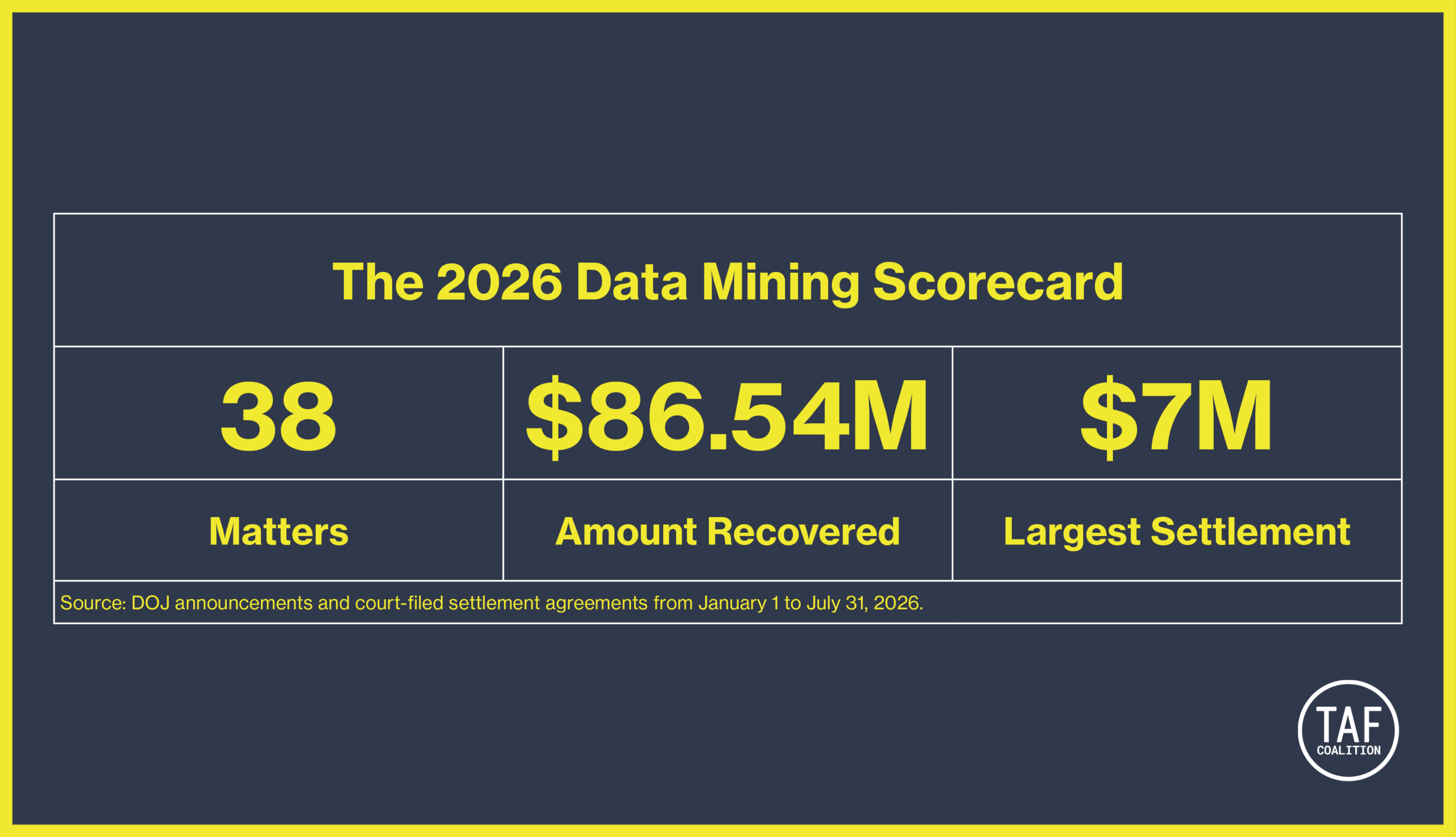
Data mining is now an established part of False Claims Act enforcement. During the first seven months of 2026, 38 data driven whistleblower FCA matters produced $86.54 million in recoveries, with individual resolutions ranging from $475,000 to $7 million.
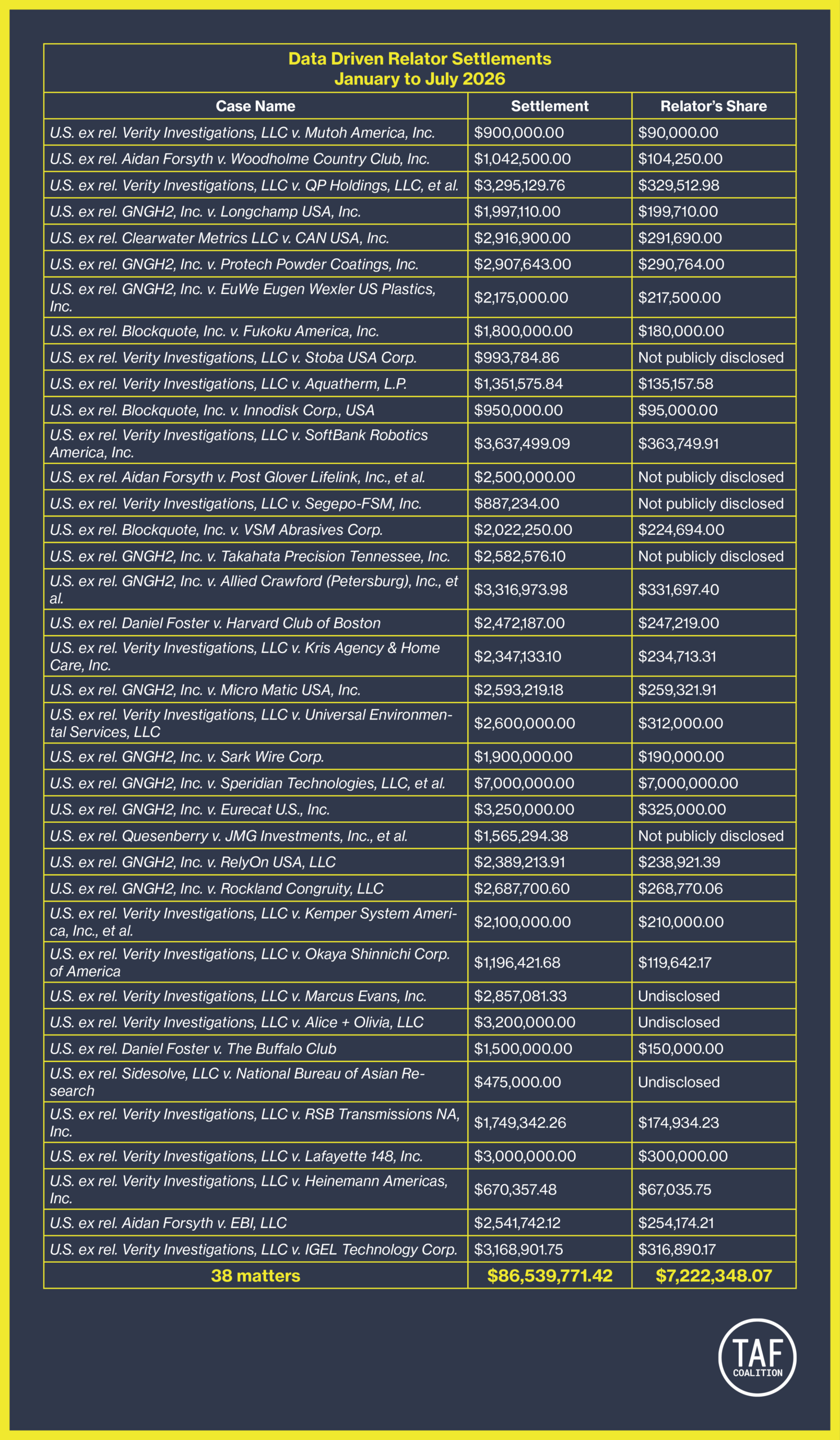
The table below lists each of the 38 matters and the relator’s share. It is notable that most of the date-driven relators are frequent filers, having filed multiple successful False Claims Act cases. Verity Investigations filed 16 of the 38 successful cases and GNGH2 filed 11.
From January through July 2026, cases filed by multiple data-driven relators resulted in significant recoveries for the government. A corporate whistleblower named Sidesolve received $1 million from a $9 million roofing settlement after using artificial intelligence and other data science tools to investigate pandemic loans. Relator LLC received approximately $507,000 from a $6.3 million dental settlement. On July 23, 2026, Verity Investigations received $363,749.91 from a $3.64 million SoftBank Robotics settlement and $316,890.17 from a separate $3.17 million software-company settlement announced the same day. And GNGH2 was responsible for the largest settlement by a data-mining relator of $7 million.
Sources: Mutoh America | Woodholme Country Club | QP Holdings | Longchamp USA | CAN USA | Protech Powder Coatings | EuWe Eugen Wexler US Plastics | Fukoku America | Stoba USA | Aquatherm | Innodisk | SoftBank Robotics America | Post Glover Lifelink | Segepo-FSM | VSM Abrasive | Takahata Precision Tennessee | Allied Crawford | Harvard Club of Boston | Kris Agency | Micro Matic USA | Universal Environmental Services | Sark Wire | Speridian Technologies | Eurecat U.S. | JMG Investments | RelyOn USA | Rockland Congruity | Kemper System | Okaya Shinnichi | Marcus Evans | Alice + Olivia | The Buffalo Club | National Bureau of Asian Research | RSB Transmissions NA | Lafayette 148 | Heinemann Americas | EBI | IGEL Technology
Data, however, is only the beginning. As TAF has explained in its blog post Mining for Gold: Examining the New Trend of Data-Driven False Claims Act Cases, an unusual number that appears to be an outlier can have an innocent explanation, and a strong case requires testing the signal against program rules, alternative explanations, and evidence of knowledge.
The Justice Department has now built a formal front door it is encouraging data-driven relators to use for this work. Under FOCUS, before filing a False Claims Act case, data miners are encouraged to submit a white paper explaining their sources, assumptions, validation, alternative explanations, and best example. Meetings are optional, but DOJ says it will prioritize analytical rigor, familiarity with program rules, and legally sufficient allegations.
The government published the data. Data-driven whistleblowers are showing what can happen when someone knows how to read it.
This piece was written by Kathleen Gallagher of Gallagher & Lipshutz, PLLC.
